How to Build a Running Plan That Matches Your Life
You downloaded a 16-week marathon plan from the internet, pinned it to the fridge, and made it to week three. Then a work trip clashed with your long run, you missed two sessions, and the whole thing fell apart. Sound familiar? The problem was never your motivation. It was the plan. A running plan only works when it fits the life you actually live – not the life a spreadsheet assumes you have.
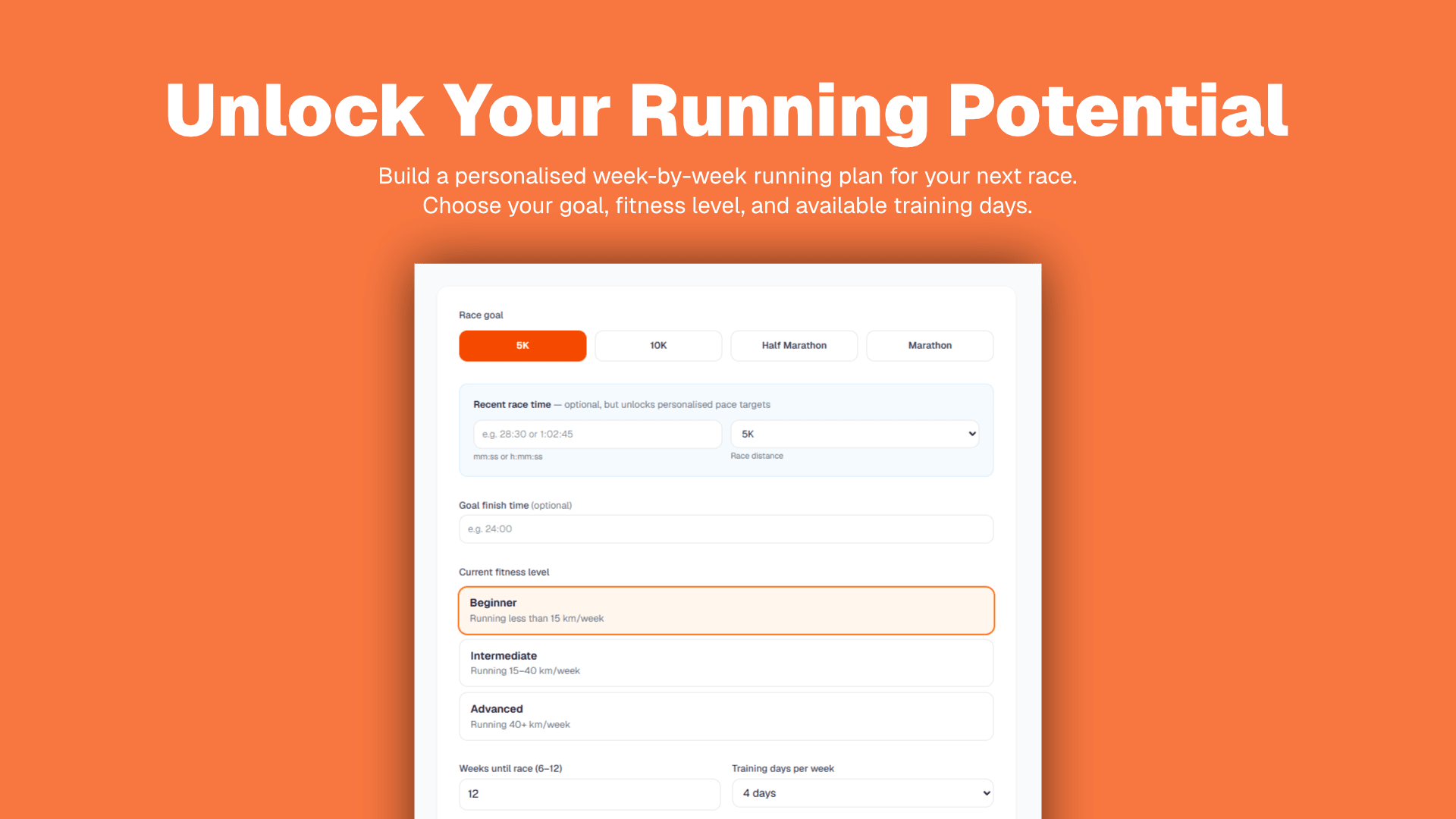
This guide shows you how to build a personalised running plan around your schedule, your fitness level and your goals – so you stick with it past week three and actually reach the start line ready.
Why Most Generic Running Plans Fail
Generic plans assume you have seven flexible days, no commute, and unlimited recovery capacity. They prescribe Tuesday intervals and Sunday long runs as if your calendar clears itself on command. Research from the British Journal of Sports Medicine shows that adherence – not intensity – is the strongest predictor of improvement in recreational runners (Hulteen et al., 2022). A plan you follow 80% of the time beats a perfect plan you abandon after a fortnight.
The issue is rigid structure. A study published by the European Journal of Sport Science found that flexible, self-regulated training schedules produced comparable fitness gains to fixed programmes in amateur endurance athletes (Schiphof-Godart et al., 2022). The runners who adjusted sessions around life stress, sleep quality and energy levels stayed healthier and more consistent.
A personalised running plan accounts for all of this. It starts with the hours you genuinely have, not the hours a template demands.
What Your Running Plan Actually Needs
Every effective plan – whether you are targeting a 5 km parkrun or a sub-4:00 marathon – rests on four building blocks. Get these right and the daily detail almost writes itself.
A clear goal with a deadline
Your plan needs a finish line: a race date, a target distance or a measurable performance goal. “Get fitter” is not a plan – “Run a 25:00 5 km by June” is. The deadline gives structure. The specificity tells you what type of training to prioritise.
Your real weekly availability
Write down the days and times you can realistically train. Be honest. If Wednesday evenings are always eaten by late meetings, do not schedule intervals there. Most runners do well on three to five sessions per week. Three quality sessions will outperform five rushed ones every time.
A balance of session types
You need easy runs, one speed or tempo session, and one longer run. The ratio matters more than the mileage. Roughly 80% of your running should feel conversational – easy enough to hold a full sentence. The remaining 20% covers intervals, tempo efforts and race-pace work. This is not a new idea; it is the polarised training model used by coaches from Renato Canova to Stephen Seiler, backed by decades of evidence in elite and recreational populations.
Built-in flexibility
A good plan has slack. If you miss Tuesday’s tempo run, you can shift it to Thursday without guilt. The week’s structure matters more than the exact day. Build one or two “float” days into every week – days where a session can land if life gets in the way.
How to Build Your Plan Step by Step

Here is the process. You can do this with a notebook, a spreadsheet, or the RunReps Running Plan Generator, which builds a personalised schedule based on your inputs in under a minute.
Step 1 – Set your goal and timeline
Pick your target race or distance. Count the weeks between now and race day. Subtract one week for a taper (two weeks if your race is a half marathon or longer). That is your available training window.
Step 2 – Audit your week
Map out a typical week. Mark the days and time slots where you can run without forcing it. Morning before work, lunchtime, weekend mornings – whatever is consistent. Consistency beats volume.
Step 3 – Assign session types
Place your long run on the day with the most free time – usually Saturday or Sunday. Slot your speed or tempo session on a day where you have energy and at least 45 to 60 minutes. Fill remaining days with easy runs. If you have three days, that gives you: one easy, one speed, one long. If you have five days, add two more easy runs.
Step 4 – Set starting distances and paces
Start from where you are, not where you want to be. If your longest recent run is 8 km, do not open your plan with a 15 km long run. A safe rule: increase total weekly distance by no more than 10% per week. Use a pace calculator to anchor your easy pace and tempo pace to a recent race result or time trial.
Step 5 – Add progression and recovery weeks
Build for two to three weeks, then drop volume by 20-30% for one recovery week. This cycle – load, load, recover – prevents overtraining and keeps you injury-free. After each recovery week, start the next block slightly above where the last one peaked.
Step 6 – Review and adjust weekly
No plan survives contact with real life. At the end of each week, check: did you complete the key sessions (the long run and the speed session)? If yes, the week was a success – even if you missed an easy run. Adjust next week based on how your body feels, not what the spreadsheet says.
A Real-World Example: Sarah’s Half Marathon Plan

Sarah is a 34-year-old project manager training for her first half marathon in 14 weeks. She can run four days a week – Tuesday and Thursday mornings before work (45 minutes each), Saturday morning (90 minutes) and a flexible slot on either Monday or Wednesday evening.
Her plan looks like this:
- Tuesday: Easy run, 5-6 km at conversational pace
- Thursday: Tempo or intervals, 6-8 km with structured efforts
- Saturday: Long run, building from 10 km to 18 km over 12 weeks
- Float day (Mon or Wed): Easy 4-5 km, or rest if the week was heavy
She uses the RunReps Running Plan Generator to set her paces based on a recent 10 km time of 55:00. The tool builds a week-by-week schedule with progression baked in, recovery weeks every fourth week, and a two-week taper before race day.
By week 10, Sarah is running 40 km per week – up from 25 km – and hitting every key session. The plan worked because it was built around her real life, not around an idealised version of it.
Common Mistakes That Derail a Running Plan
Even a well-built plan can go wrong. Watch for these patterns:
- Starting too fast: Running every easy day at tempo pace is the fastest route to injury. Slow down. Your easy runs should feel almost too easy.
- Skipping recovery weeks: Fitness grows during rest, not during the hard sessions. Cut the recovery week and you stall – or worse, you break down.
- Ignoring signs of fatigue: Persistent tiredness, elevated resting heart rate, and heavy legs on easy runs are signals to back off. A missed session costs you nothing. A stress fracture costs you months.
- Treating the plan as law: The plan is a guide. Move sessions around. Swap a speed day for an easy run when you are tired. The best runners adapt constantly.
When to Use a Plan Generator Instead
Building a plan manually works well if you enjoy the process and have coaching knowledge. But for most runners – especially those training for a specific race distance – a structured plan generator removes the guesswork. You enter your goal, your available days, and your current fitness, and the tool handles the periodisation, pacing and taper.
The advantage is precision. A generator calculates your training paces from real data, sequences your long runs and speed sessions in the right order, and builds recovery into the schedule automatically. You still own the decisions – you choose when to swap a session or take an extra rest day – but you start with a solid framework instead of a blank page.
Questions Runners Ask About Building a Training Plan
How many days per week should I run?
Three days is the minimum for meaningful progress. Four to five days works well for most runners training for 10 km or longer. Beyond five days, the injury risk rises sharply unless you have years of consistent mileage behind you. Quality matters more than quantity – three focused sessions beat six unfocused ones.
Can I follow the same plan for a 5 km and a marathon?
No. The demands are fundamentally different. A 5 km plan emphasises speed and VO2max work. A marathon plan prioritises aerobic endurance and long runs. The session types, weekly volume and taper length all change with the target distance. Use a plan that matches your specific race goal.
What happens if I miss a week of training?
One missed week barely dents your fitness. Research shows that aerobic capacity holds steady for up to two weeks of reduced training in well-conditioned runners. Pick up where you left off – do not try to cram the missed sessions into the following week. That is how injuries happen. If you miss more than two weeks, dial back the intensity for a few days before resuming your normal schedule.
Should I run by pace or by feel?
Both. Use pace targets as a guide – they keep you honest on easy days and give you benchmarks for speed sessions. But listen to your body. If your easy pace feels hard on a hot day or after a bad night’s sleep, slow down. The effort matters more than the number on your watch.
This article is for informational purposes only and does not constitute medical advice. If you are new to running or returning after injury, consult a qualified healthcare professional before starting a new training programme.
Disclosure: Some links on this website are Amazon affiliate links. As an Amazon Associate, we earn from qualifying purchases.